
The Fourth Stonecutter
Recovering Meaning and Purpose in the Age of AI

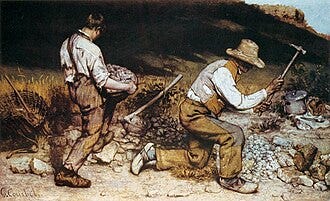
In 1849, Gustave Courbet painted The Stonebreakers — two figures hunched over rock, faceless, anonymous, grinding. We feel it today as we answer the 100th email of the day.
Courbet was a Realist . Where Soviet-era murals glorified the heroic machinist gazing toward a radiant future, and Rosie the Riveter turned factory work into feminist empowerment, Courbet refused to ennoble the grind. He painted what he saw: two men breaking rocks. No glorification.
There’s an old medieval parable about three stonecutters. A traveller asks each what they’re doing.
The first, miserable: “I’m cutting this friggin’ rock.”
The second, more purposeful: “I’m building an immense wall.”
The third, joyful: “I’m creating a magnificent cathedral.”
Courbet’s stonebreakers represent the first stonecutter — trapped in the Realist frame, no story to rescue them. The parable’s lesson is that meaning is created by each stonecutter's story. Viktor Frankl, in Man’s Search for Meaning, suggested that amidst horror, drudgery, and hardship, what his captors could not remove is the human power to create meaning - the why of our work.
But the parable has always stopped at three.
Nobody has asked what happens when AI arrives at the building site.
Does AI destroy meaning at work, or reveal that it was already missing?
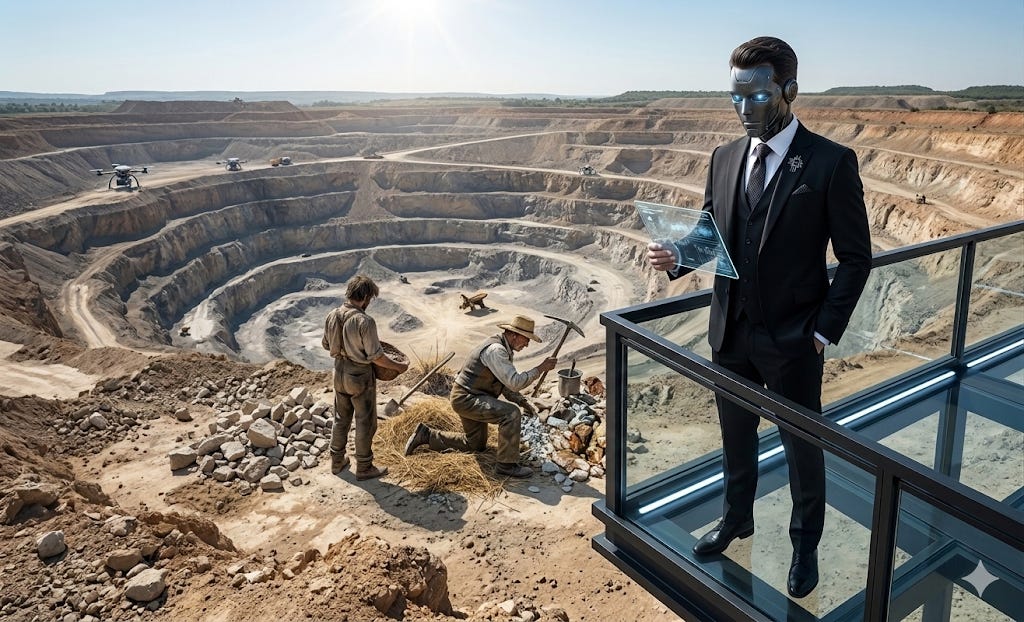
If we’re not careful, AI reduces everyone to the first stonecutter. The rock is cut by machines. The wall is designed by algorithms. The cathedral is optimised by a system that doesn’t care about cathedrals. The human sits beside the machine, monitoring a dashboard, stripped of the craft that once gave the work its meaning.
That’s one future. It’s the one most people are afraid of.
But here’s the uncomfortable truth we need to sit with before we reach for solutions: most of what AI is automating today wasn’t providing much meaning in the first place.
The lead research. The data entry. The compliance reporting. The formatting of slides. The scheduling of meetings about meetings. These tasks filled our days and gave us the feeling of being busy — but busy is not the same as purposeful.
We constructed elaborate identities around expertise that was, at root, pattern-matching and administrative processing. We told ourselves we were building cathedrals when we were really just moving rocks from one pile to another.
I have OpenClaw working while I sleep, market research, reading 10 newspapers, handling 400 emails, checking stock prices, and researching events to speak at. Cost? Three bucks. The biggest surprise isn’t the efficiency. I sit down with a head that is clear of drudgery, and freed for creativity and writing - the stuff I love.
That should make us pause. If a machine can do your Tuesday grind for three bucks, what was your Tuesday really worth — to you, as a source of meaning?
The real test comes next. AI won’t stop at the gravel. It will encroach on work that genuinely feels meaningful — writing, designing, strategising, teaching. When a founder can wake up not just to 47 completed tasks but to a finished draft, a completed design, a fully modelled strategy — does that enrich her life? Or does it hollow it out?
This is the question the Intelligent Enterprise must answer. And the answer is not to cling to drudgery out of fear, or to invent new forms of busywork to fill the vacuum. The answer is to reach for something higher.
The fourth stonecutter
But there’s another possibility — one that demands a fourth stonecutter.
The Fourth Stonecutter was, yesterday, the third. Joyful. Purpose-driven. But constrained by the limits of her own hands and hours. She could envision the cathedral, but could only cut one stone at a time. She understood the grand design but lacked the tools to shape it.
Today, she discovers that with AI, she can do something none of the original three could imagine.
She can design the cathedral herself.
She can move rocks with machines, model structural loads with algorithms, and test a thousand variations of the rose window before a single pane is cut. The grinding, the measuring, the repetitive shaping — handled. But far from hollowing out her purpose, this expands it. She is no longer limited to the role of inspired labourer within someone else’s vision.
She has been uplifted — in capability and in purpose.
The Fourth Stonecutter says, “I designed this cathedral. I orchestrated the machines that built it. I made choices about beauty, proportion, and meaning that no algorithm would have made on its own. And I did it with tools that let me build something I could never have built alone.”
This is not the “curator of the prompt” — a diminished role dressed up in empowering language. This is an expansion of what one human can do.
What poker taught me about AI “co-mastery”
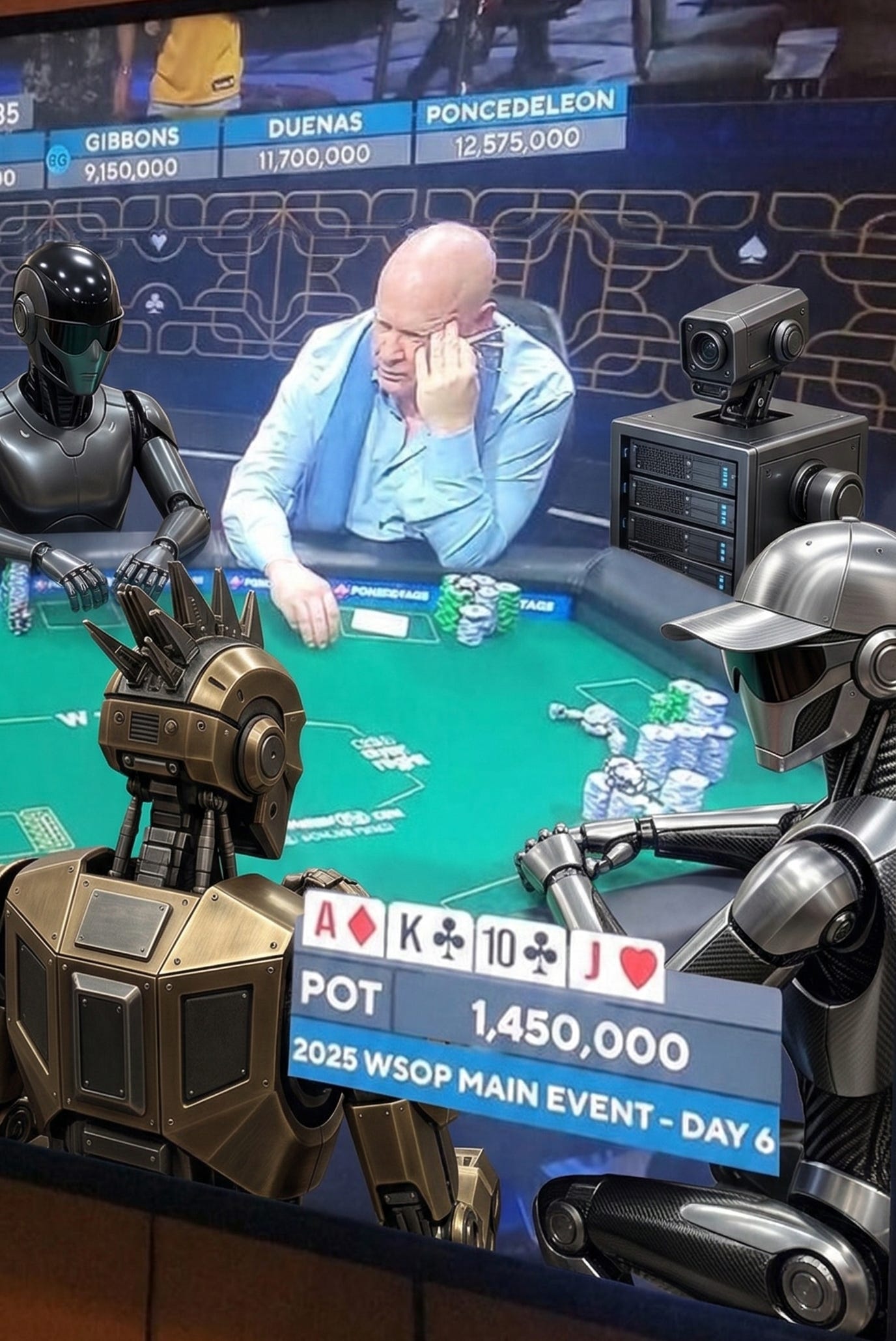
Secret: I play high-stakes poker, on TV, sometimes for tech bro salaries. AI has transformed the game. Bots play a game theoretically optimal (GTO) strategy that no human can match. And yet human poker is more popular than ever. Tournament fields are exploding. A moderately serious player today would destroy the best in the world from 2000. (Give me a Tardis, and one week in Vegas in the year 2000, please.)
Why? Because players use AI to train. They study solver outputs to understand depths they couldn’t access alone. The AI didn’t kill the game — it elevated it. The struggle remains, but at a higher plane.
This is Co-Mastery. Not human versus machine. Human via machine — becoming better than you were.
Forget the productivity J-curve: the meaning J-curve
Economics is called “the dismal science” for a reason. Economists discuss the economic disruption of AI endlessly — jobs lost, industries reshaped, SaaS-pocalypses. We love Ricardo’s J-curves.
But there’s a deeper disruption: the disruption to meaning itself.
Work has been the primary source of identity, purpose, community, and mastery for most adults. When AI restructures work, it restructures all of that too. There will be what I call a meaning J-curve — a period where purpose collapses faster than new sources of meaning can be built.
The accountant who took pride in precision. The analyst who was valued for synthesis. The writer who found identity in craft. When the machine does these things faster and cheaper, the meaning scaffolding falls before anything replaces it.
The trough will be painful.
But the upslope is real — if we design for it. The upslope looks like the Fourth Stonecutter: humans freed from execution, finding new meaning in creativity, in mastery at higher levels of abstraction, in the distinctly human work of deciding what is worth building.
David Hume argued that reason can tell us how to achieve what we want, but never what to want or why it matters. AI is the most powerful reasoning engine ever built. It is extraordinary at means. But it is constitutionally silent on ends.
You cannot derive a value from a dataset.
The cathedral-or-hospital decision? That’s ours. Permanently.
The automated overnight agent that completes fifty tasks while you sleep is a marvel. But the real marvel is the morning after: the human who sits down at her desk, unburdened by drudgery, and chooses to do something that matters.
Something that requires her judgment. Her vision of what matters. Her courage. Her care.
The machine can tell her how. Only she can say why.
That’s the Fourth Stonecutter. And she’s the future of work worth building toward.
This is drawn from a chapter of my forthcoming book, Intelligent Enterprises.
More on the meaning J-curve, the case for de-workification, and what the Intelligent Enterprise owes to human flourishing — coming soon.
I’m Paul Gibbons — I work with leadership teams navigating AI adoption through the human side: change, leadership, culture, capability. If this resonated, follow along or reach out.