
Designing organizations for machine intelligences
Undiscovered country - a problem nobody has solved

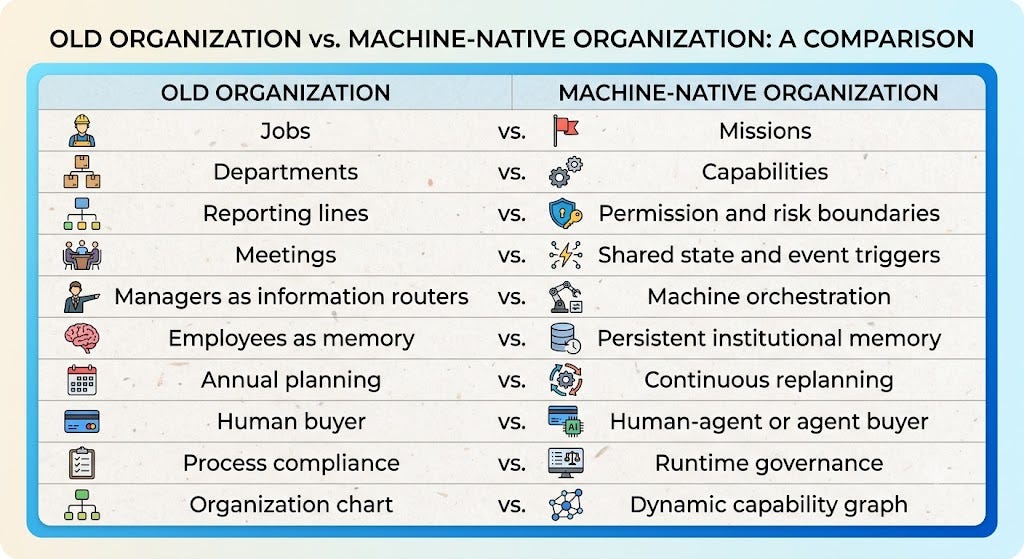
What organizational form would we create if intelligence, memory, coordination and execution were predominantly machine capabilities rather than scarce human capabilities?
Nobody yet has a convincing answer. There is emerging literature on “AI-orchestrated” and “fluid” organizations, but most of it still begins with the existing enterprise and asks where agents should be inserted. It assumes human accountability, human organizational goals and recognizable human roles. That is organizational augmentation, not first-principles redesign.
The modern organization is an accommodation to human limitations
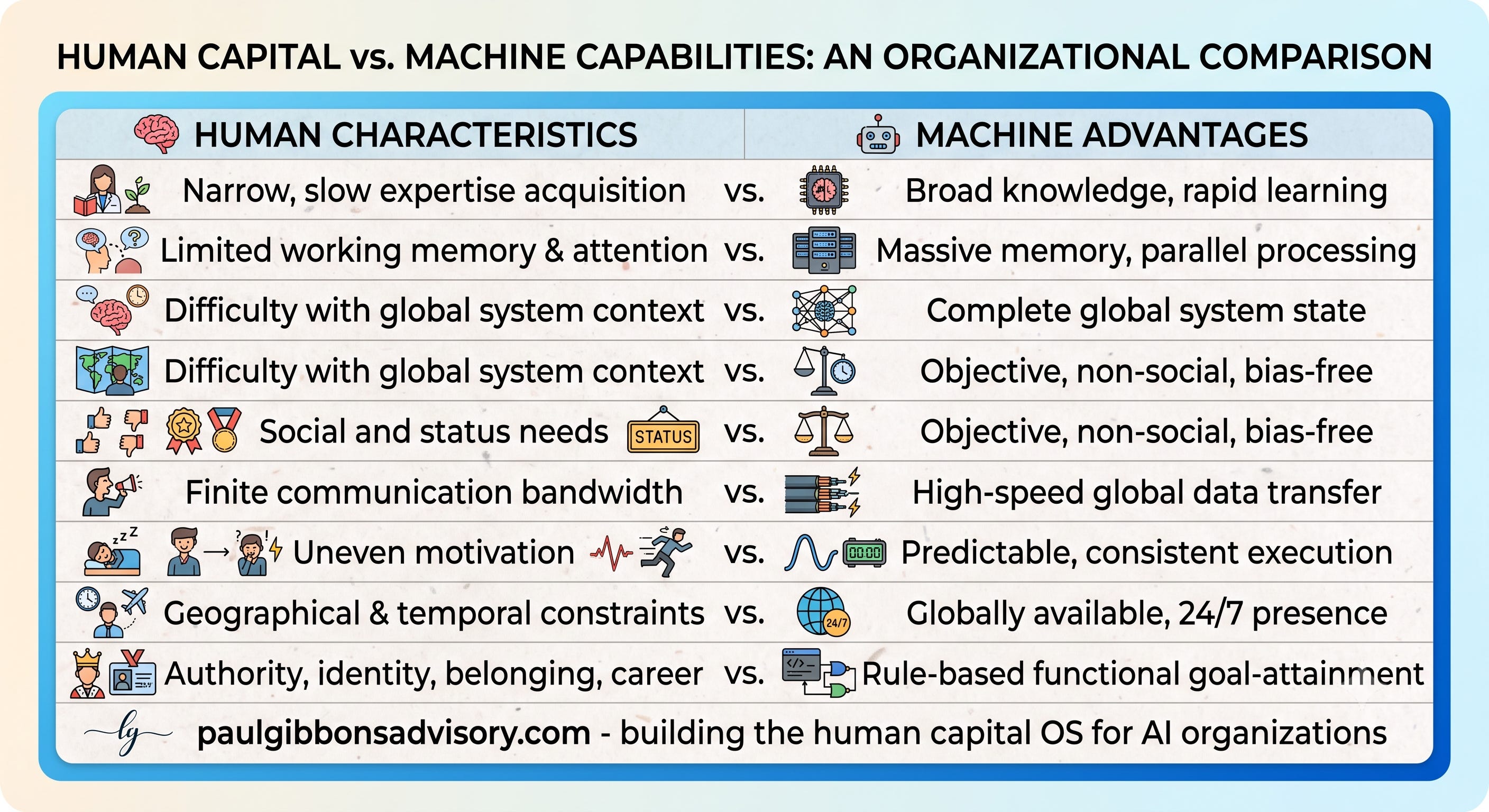
The familiar corporation is not a natural or inevitable way to organize productive activity. It is an evolved response to several characteristics of human beings.
Humans have:
narrow expertise acquired slowly;
limited working memory and attention;
difficulty maintaining context across large systems;
social and status needs;
finite communication bandwidth;
uneven motivation;
geographical and temporal constraints;
and a need for authority, identity, belonging and career progression.
Departments reflect educational and professional silos: finance people go into finance, marketers into marketing, engineers into engineering. Hierarchy compresses information because the chief executive cannot communicate meaningfully with 20,000 individuals. Middle management filters, translates, prioritizes, coordinates and reconciles.
Much of what we call “management” is therefore human glue:
moving information between functions;
convening meetings;
resolving ambiguities;
persuading people to cooperate;
translating one professional dialect into another;
locating knowledge;
monitoring progress;
allocating attention;
and preserving organizational memory through personal relationships.
That glue is expensive, slow and lossy. But historically it was necessary.
Computing automated transactions, not organization
This explains why fifty years of accessible computing barely altered the fundamental organizational form.
ERP systems computerized transactions. Email accelerated messages. Databases stored records. Workflow systems routed forms. Collaboration platforms proliferated communication. But none of those systems could understand what the organization was trying to do, interpret ambiguity, generate a plan, reconcile inconsistent information or act autonomously across functional boundaries.
Indeed, much enterprise computing reinforced the organization chart. Finance acquired finance systems, HR acquired HR systems, sales acquired CRM, operations acquired ERP and IT became responsible for connecting them. The digital enterprise reproduced the functional enterprise in software.
It often made the organization faster at generating information while simultaneously creating more need for human coordination.
Generative and agentic AI are different because they attack the semantic and coordinative layer. An agent can interpret, synthesize, decide, generate, negotiate and execute across systems. OpenAI reports that its own use of Codex has spread beyond engineering into departments such as legal and recruiting, with agents increasingly performing longer and more cross-functional work. Yet even this remains largely an example of capable tools entering existing departments—not proof that departments remain the correct structure. OpenAI
The crucial change is not task automation
Most corporate AI programs ask:
Which human tasks can we automate?
That question preserves the existing decomposition of work. It assumes that jobs, processes, functions and reporting relationships are approximately correct and that AI should replace pieces of them.
The first-principles question is:
Given a goal, a set of assets, constraints and legitimate stakeholders, how should intelligence and execution be organized?
That may produce no recognizable HR department, marketing department, product department or middle-management structure.
The machine-native organization might instead be composed of:
persistent objectives;
constraints and policies;
a shared institutional memory;
dynamic capability agents;
temporary mission structures;
decision and escalation protocols;
continuous sensing and feedback;
and a relatively small number of humans responsible for legitimacy, purpose and exceptional judgment.
The unit of organization would no longer be the job. It would be the mission.
The unit of capability would no longer be the department. It would be an addressable combination of models, tools, data, permissions and expertise.
The organization chart would become a dynamic computational graph.
Hierarchy would change function
Hierarchy probably does not disappear completely. But its primary purpose would change.
In the traditional organization, hierarchy serves two distinct functions:
Information routing and coordination
Authority, accountability and legitimacy
Machine intelligence could eliminate a large fraction of the first. Information would no longer have to travel upward through successive managerial filters and then back downward as instructions. A shared system could sense an event, interpret its implications, identify affected activities, generate options and initiate authorized actions almost immediately.
But the second function remains. Someone must define the objective, bear legal responsibility, resolve genuinely normative questions and represent the organization to society.
So hierarchy may survive as an authority topology, while disappearing as an information architecture.
That distinction is foundational.
A machine-native enterprise might have very few permanent managerial levels while retaining explicit human control over capital allocation, legal commitments, safety boundaries, public consequences and changes to the organization’s constitutional objectives.
Tacit knowledge is the present bottleneck
Right how, humans are the keepers of tacit knowledge. Perhaps not for long. As AI systems get embedded into workflows, advanced AI memory systems will have ontologies for capturing tacit knowledge. That is, the esoteric knowledge that lives inside people’s heads will become more explicit.
Maybe not ALL tacit knowledge will become explicit. Some knowledge is embodied, relational and contextual: how a particular executive reacts under pressure, whether a supplier is concealing anxiety, how a manufacturing process sounds immediately before failure, or what a client means when the formal words say something else.
But the economically decisive question is not whether all tacit knowledge can be codified.
It is whether enough of it becomes machine-accessible that humans cease to be indispensable storage devices.
Continuous transcripts, workflow traces, decision records, video, operational telemetry, correspondence, model-generated summaries and institutional memory systems can capture vastly more of organizational life than conventional documentation ever did. Models can infer patterns from behavior without requiring the human expert to explain every rule.
Thus the human expert may remain the original source of some knowledge without remaining its sole custodian.
That is a profound change in bargaining power and organization design. Today, when a senior engineer, salesperson or operations leader leaves, a network of undocumented judgments often leaves with them. In a sufficiently instrumented organization, departure may mean losing a relationship or an exceptional mind—but not losing the entire history of how work was performed.
AI as customer changes the external boundary of the firm
The purchasing point is equally important.
Agentic commerce is already moving from recommendation toward execution. Visa is building infrastructure for AI-initiated transactions, agent authentication, authorization and spending controls. Gartner forecasts that by 2030, half of cross-functional supply-chain-management solutions will use intelligent agents to autonomously execute decisions; it explicitly gives autonomous procurement as an example. visa.com
Consumer forecasts are also substantial: Bain estimates that agents could influence or complete 15–25% of US e-commerce transactions by 2030, although end-to-end consumer trust remains a constraint. bain.com
B2B technology is likely to move first because it is unusually machine-legible:
specifications are relatively formal;
performance is measurable;
prices and licenses are digital;
products can be trialled automatically;
security and compliance evidence can be queried;
and delivery may occur immediately through APIs or software deployment.
The future buyer may ask:
Find the database, model, cybersecurity service or cloud configuration that satisfies these latency, regulatory, reliability and cost constraints. Test the candidates, negotiate terms within this authority envelope and purchase the best option.
At that point, the seller is no longer primarily persuading a person. It is satisfying an evaluative system.
That changes sales and marketing fundamentally. Machine customers will care about:
accessible product data;
verifiable performance;
machine-readable pricing;
trustworthy provenance;
security attestations;
integration friction;
contractual constraints;
service history;
and evidence that can be independently tested.
Brand does not disappear, because reputation itself becomes a decision variable. But brand must become computable trust rather than merely emotional salience.
The B2B sales organization built around account executives, sales engineers, procurement negotiations and months-long human courtship could shrink sharply in categories where buyer and seller agents can establish fit, risk and price directly.
The IBM problem
IBM is a corporation with more than a quarter-million humans contains enormous amounts of coordination latency. Every major decision encounters functions, geographies, systems, incentives, committees, budgets, permissions and local interpretations.
My experience as a partner is illustrative. Hired to run their leadership-future of work “eminence” (thought-leadership) I began to produce - and as an experienced researcher-writer - a serious piece of content to compete with our competitor firms, Accenture and McKinsey, in about 3-5 weeks. However, getting IBM thought-leadership pieces through the system might take six months, even for something as short as a blog post.
In other words, the system was explicitly designed with frictions so slow innovation and output.
And in the AI world, six months is an eternity. Little that was written in 2025 has any relevance today.
IBM has extraordinary assets:
customer trust;
installed infrastructure;
data;
patents;
capital;
regulatory knowledge;
distribution;
and deep domain expertise.
Those assets may remain highly valuable. The human bureaucracy used to coordinate them may not.
IBM need not disappear as a legal entity or commercial platform. But it may be unable to survive in its present organizational form if AI-native competitors can produce comparable outcomes with one-tenth or one-hundredth the human coordination burden.
The successful incumbent would have to become something resembling a federation of machine-intensive enterprises, sharing capital, governance, infrastructure and brand while operating with far more autonomous and computationally mediated units.
That would be transformation in the literal sense—not a workforce with better copilots.
The strongest counterargument
There is a serious alternative possibility: AI may make very large corporations more viable rather than less.
Historically, organizations stop growing when internal coordination costs overwhelm the advantages of scale. If AI dramatically lowers those internal coordination costs, a corporation might manage far more products, markets and activities than any human bureaucracy could.
A gigantic enterprise with unique data, enormous compute, established customer access and powerful agents might coordinate resources more effectively than a small entrant. The result could be fewer but even larger firms.
There are also durable human constraints:
law assigns responsibility to people and legal entities;
legitimacy cannot simply be computed;
objectives remain contested;
power and politics do not vanish;
customers may demand human accountability;
physical work remains significant;
and machine systems can fail systematically at enormous scale.
Therefore, “AI means every large company dies” is too strong.
IN THEORY, AI could make bureaucracy more efficient.
However, bureaucrats have something to say about that. Turf to protect,: people whose job it is to make sure other people don’t do their jobs.
This is a prediction - take it as such - very few large enterprises have the change capability to do this. Perhaps none. And there is a moral case - those bureaucrats have families to feed.
My view
I expect a bifurcation.
We will see:
a small number of extremely large platform, infrastructure and capital-owning enterprises;
and a vast number of very small, extraordinarily capable AI-native operating companies.
What becomes endangered is the middle: the large, labour-intensive, managerial corporation whose principal competency is coordinating thousands of knowledge workers through hierarchy and process.
The corporation may remain large in revenue, assets, reach and computational activity while becoming radically smaller in human headcount.
So my summary view:
The twentieth-century corporation was built to coordinate scarce human intelligence. The AI-native corporation will be built to govern abundant machine intelligence.
And that means we are not merely building agents, memory or orchestration.
The square peg is not AI.
The square peg is the inherited corporation.
Machine intelligence will break our org charts long before it breaks our models, and your piece frames exactly why. The part I would add from the field is the transaction layer. Once software acts on its own behalf, money moves at machine speed while our controls still assume a person is watching. I wrote about a case where an order cleared in seconds and the card behind it was already dead. Org design and fraud are the same frontier from two sides, institutions built for human latency meeting systems that have none. The winners will redesign trust before they redesign headcount.
https://cyrilsimonnet.substack.com/p/the-order-went-through-and-the-card
Superb. I talk elsewhere about 5 clock speeds. AI days and weeks. Human skills and behaviors months and years. Governance and system. Years. Thanks for your comment will read your piece.