

Current whitepapers from prestige firms name 90+% of the impediments to AI adoption are human issues — culture, change capability, leadership, resistance, readiness. (This strikes me as “finger in the air” research, but lets allow that it is directionally correct.)
It is the highest figure in that survey's fifteen-year history, and it ought to be the most consequential number in any boardroom conversation about artificial intelligence.
It is not.
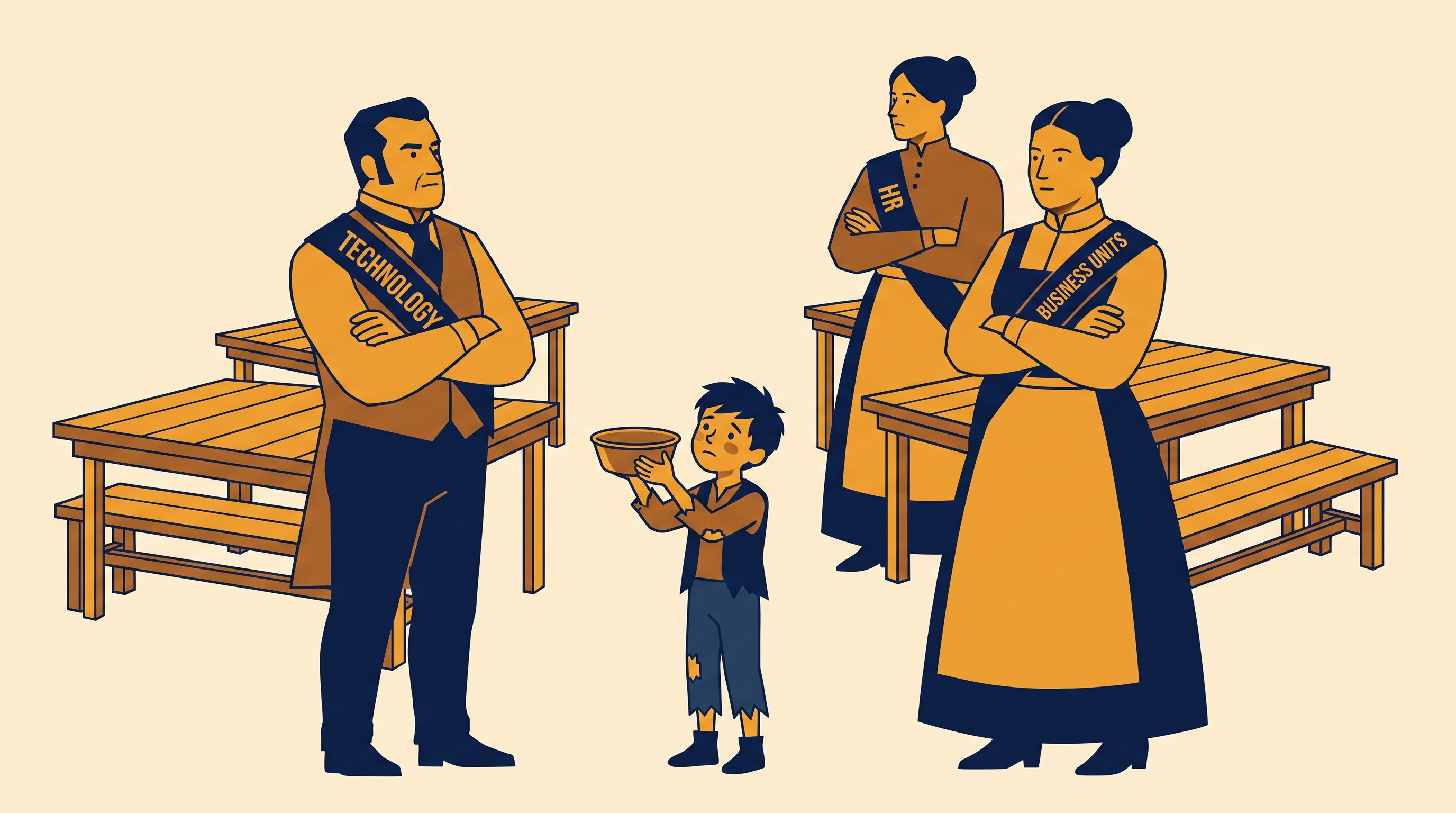
The typical enterprise response to a human-systems problem is to hope that a steering committee will consider such factors. But a committee is a structure for sharing responsibility, not for holding it. Everyone is consulted, no one is accountable. The technology function owns the spend, the business units own the outcomes, HR owns the workforce — and the gap between them is precisely where the returns go missing.
AI is everywhere in the enterprise, and formal accountability for it is falling between three stools.
This is not an argument for yet another seat at the table. It is an argument for putting the authority to decide in the same place as the accountability for the outcome — the oldest principle in organisational design, and the one most reliably abandoned the moment something feels too novel to govern normally.
A Chief AI Officer is not a technologist with a larger title. The role sits where strategy, workforce and governance intersect, and its first job is to answer a question most firms currently cannot: what operational metric moved, against what control, and what did the absorption capacity cost?
I have set out the case in a discussion document — what the role owns, where it reports, what it is not, and the conditions under which a fractional appointment beats a permanent one.
Read the whitepaper → https://paulgibbonsadvisory.com/whitepapers/case-for-a-chief-ai-officer/
"A committee is a structure for sharing responsibility, not for holding it" belongs on every AI steering deck. Your question about which operational metric moved is the one most programs can't answer, because nobody owned a baseline before the rollout. For a firm too small for a Chief AI Officer, where should that accountability sit first, operations or the business unit?
An excellent observation on the importance of single point accountability during a time of significant change.